Table of Contents
ToggleShipping Container Foundations: Everything You Need to Know (2026)
A shipping container is built to be strong, durable, and capable of carrying heavy loads, but the ground underneath it still matters. A properly prepared foundation helps keep the container level, reduces moisture exposure, improves drainage, and protects the structure over time.
Whether you are purchasing a 10ft, 20ft, 40ft, or 45ft container, choosing the right foundation should be part of your planning before delivery.
If you’re still deciding which size is appropriate, our guide to Shipping Container Sizes Explained: 10ft, 20ft, 30ft, 40ft & 45ft can help you compare the available options.
This guide explains the most common shipping container foundation options and what you should consider before your container arrives.
Why Does a Shipping Container Need a Foundation?
Shipping containers have strong steel frames, but they are not designed to simply sit on uneven ground indefinitely.
A suitable foundation can:
- Keep the container level
- Support the container’s structural frame
- Reduce movement and settling
- Improve drainage underneath the container
- Reduce prolonged contact with wet soil
- Make doors easier to open and close
- Help protect the container from corrosion
- Improve long-term stability
The foundation does not necessarily need to be complicated. For many storage applications, a properly prepared gravel base can be sufficient. Other applications may benefit from concrete foundations or piers.
Common Shipping Container Foundation Options
There are several ways to prepare a foundation for a shipping container. The best option depends on the container’s size, intended use, soil conditions, climate, and local requirements.
1. Gravel Foundation
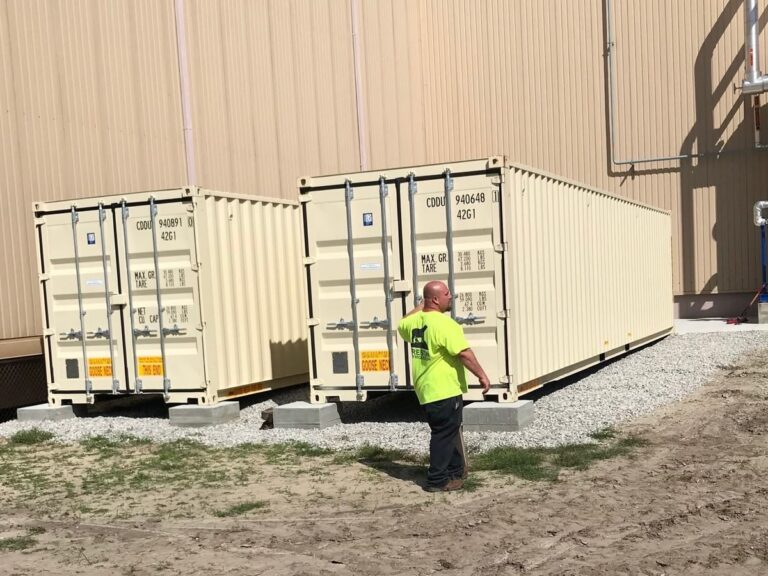
A compacted gravel pad is one of the most practical options for many shipping container installations.
The area is cleared, leveled, and filled with suitable aggregate before being compacted into a stable surface.
Advantages of gravel
- Relatively affordable
- Good drainage
- Easier to install than a large concrete slab
- Can work well on many residential and commercial properties
- Helps keep the container elevated above surrounding soil
Gravel is particularly useful when the primary purpose of the container is storage.
However, the gravel needs to be properly compacted. Loose gravel can shift under the container and eventually create an uneven foundation.
2. Concrete Slab
A concrete slab provides a solid, permanent surface for a shipping container.
It can be an excellent choice when the container will be used for a long-term installation, workshop, office, or other conversion.
A concrete foundation can provide:
- Excellent stability
- A level installation surface
- Easy access around the container
- A durable long-term foundation
- A clean surface for converted spaces
However, concrete generally costs more and requires more preparation than a basic gravel foundation.
The slab should also be designed appropriately for the container and local soil conditions rather than simply pouring concrete without considering load and drainage requirements.
3. Concrete Piers or Blocks
Another approach is to support the container’s structural frame at several points using properly designed piers or supports.
This method can reduce the amount of concrete required while keeping the container elevated from the ground.
The important consideration is proper weight distribution.
The supports should be positioned beneath the container’s structural frame and should provide a stable, level surface.
For permanent or structural installations, consult a qualified local contractor or engineer to determine the appropriate foundation design.
Gravel vs. Concrete: Which Is Better?
There is no single foundation that is best for every container.
Gravel is often a good choice when:
- The container is primarily for storage
- You want good drainage
- You want a lower-cost installation
- The site has suitable ground conditions
- The container may eventually be relocated
Concrete may be better when:
- The container will remain permanently
- You are creating an office or living space
- You need a highly stable surface
- The site requires a permanent foundation
- Local building requirements call for concrete or engineered support
The key is not simply choosing the most expensive foundation. The foundation should match the container’s intended use and the conditions at the installation site.
How Large Should a Shipping Container Foundation Be?
The foundation should provide adequate support for the container while allowing water to drain away from the structure.
The exact dimensions depend on the container size and foundation type.
For example, a foundation for a 20ft container will generally be smaller than one designed for a 40ft or 45ft container.
Before preparing the site, confirm the actual external dimensions of your container and account for the required working space around it.
Our How to Choose the Right Shipping Container for Your Needs guide can also help you determine which container size makes sense for your property.
Support the Container’s Structural Frame
One of the most important foundation principles is understanding where a shipping container carries its weight.
The strongest structural components are concentrated around the container’s frame, particularly the corner posts and bottom rails.
This means the foundation should provide proper support to these structural areas rather than relying on random points underneath the floor.
For this reason, simply placing a container directly on several unstable objects or uneven blocks is not a good long-term foundation strategy.
Why Leveling Matters
A container should sit level on a stable foundation.
An uneven foundation can cause problems such as:
- Doors becoming difficult to open
- Doors not sealing properly
- Uneven loading
- Stress on the container frame
- Water drainage problems
- Increased movement or settling
Even a strong container can develop operational problems if it is installed on an unstable or severely uneven surface.
Before the container is delivered, make sure the foundation is properly leveled and compacted.
Drainage Is Just as Important as Stability
Water is one of the biggest concerns when preparing a container site.
A foundation should help prevent water from collecting underneath or around the container.
Good drainage can reduce:
- Standing water
- Mud
- Soil erosion
- Long-term moisture exposure
- Corrosion risks
A gravel foundation can be particularly useful because water can drain through the aggregate rather than remaining trapped around the container.
Your site should also be evaluated for natural slopes and areas where rainwater tends to collect.
Should You Put a Shipping Container Directly on the Ground?
It is generally better to avoid placing a shipping container directly on bare soil when possible.
Direct ground contact can expose the underside of the container to moisture and make drainage more difficult.
Soft soil can also settle unevenly, potentially causing the container to become unstable or out of level.
A properly prepared foundation creates separation between the container and the ground while providing a more stable installation surface.
Foundations for Different Container Sizes
The larger the container, the more important proper site preparation becomes.
10ft Containers
A 10ft container requires less space and may be easier to install on smaller properties. A compacted gravel foundation can work well for many storage applications.
Explore 10ft Shipping Containers for Sale if you need a compact storage solution.
20ft Containers
20ft containers are among the most versatile options and can be installed on gravel, concrete, or other properly prepared foundations depending on the application.
See 20ft Shipping Containers for Sale for available 20ft options.
30ft Containers
A 30ft container requires a longer, properly prepared support area. Foundation planning becomes especially important when the container will remain on the property for an extended period.
40ft Containers
Because of their greater length and weight, 40ft containers require careful attention to leveling, support, drainage, and access.
You can explore 40ft Shipping Containers for Sale when a larger storage footprint is needed.
45ft Containers
A 45ft container requires an appropriately sized and properly prepared installation area. Make sure your property has sufficient room for both the foundation and delivery equipment.
See 45ft Shipping Containers for Sale for larger-capacity options.
What About High Cube Containers?
High Cube containers provide additional interior height compared with standard-height containers.
The foundation requirements are generally based on the container’s structural footprint and installation conditions rather than simply its height.
If you’re considering additional interior clearance, see High Cube Shipping Containers for Sale and make sure the delivery site has adequate overhead clearance.
Preparing the Site Before Building the Foundation
Before installing your foundation, inspect the property carefully.
Step 1: Choose the location
Select a location that provides:
- Stable ground
- Good drainage
- Adequate access
- Enough room for the container
- Sufficient clearance around the container
Step 2: Remove unsuitable material
Remove vegetation, debris, loose soil, and other materials that could interfere with the foundation.
Step 3: Level the area
The installation area should be properly graded and prepared before the foundation material is installed.
Step 4: Compact the base
For gravel foundations, proper compaction is essential.
Step 5: Check drainage
Make sure rainwater has somewhere to go instead of collecting underneath the container.
Step 6: Verify measurements
Double-check the foundation dimensions and container dimensions before delivery.
Do Used Containers Need a Different Foundation?
Not necessarily.
A used shipping container still needs a stable, level foundation regardless of its condition.
However, inspecting the container’s condition before installation is important.
If you’re purchasing a used unit, our Used Shipping Containers for Sale: The Complete Buyer’s Guide (2026) explains what buyers should look for when evaluating used containers.
The container’s condition and the foundation are separate considerations: a good foundation cannot compensate for a container with serious structural damage.
Foundations for Container Homes and Offices
Foundation planning becomes even more important when a shipping container is being converted into a home, office, cabin, or other occupied space.
A converted container may involve:
- Windows and doors
- Insulation
- Electrical systems
- Plumbing
- Interior walls
- Flooring
- HVAC equipment
- Additional structural modifications
These projects can have requirements that go beyond a simple storage container installation.
If your project involves a conversion, start with Container Homes & Offices: The Complete Buyer’s Guide (2026) and check local building and zoning requirements before construction.
Do You Need a Concrete Foundation?
Not always.
A concrete foundation can be an excellent option, but it is not automatically required for every shipping container.
The appropriate foundation depends on:
- Container size
- Intended use
- Soil conditions
- Drainage
- Climate
- Installation duration
- Local building requirements
- Whether the container is being modified
For a basic storage application on suitable ground, a properly prepared gravel foundation may be practical.
For permanent or habitable structures, professional advice is recommended.
Foundation Mistakes to Avoid
Avoid these common mistakes when preparing your container site:
❌ Placing the container on soft ground
Soft soil can settle and cause the container to become uneven.
❌ Ignoring drainage
Standing water around the container can create long-term problems.
❌ Using uneven supports
Improperly positioned or unstable supports can create unnecessary stress on the container.
❌ Skipping compaction
Loose gravel can shift under the container’s weight.
❌ Building before checking local requirements
Some locations may require permits, engineered foundations, setbacks, or other approvals.
❌ Forgetting delivery access
A perfect foundation is not useful if the delivery equipment cannot reach the site.
Final Shipping Container Foundation Checklist
Before your container arrives, confirm:
☐ The installation location has been selected
☐ The ground has been cleared
☐ The foundation is level
☐ Gravel or concrete has been properly prepared
☐ The foundation provides adequate structural support
☐ Drainage has been considered
☐ Delivery access has been checked
☐ Overhead clearance has been verified
☐ Local requirements have been reviewed
☐ Container dimensions have been confirmed
A little preparation before delivery can prevent major problems later.
Final Thoughts
A shipping container is only as practical as the site where it is installed. Choosing the right foundation helps protect the container, maintain proper alignment, improve drainage, and support long-term use.
For many storage applications, a properly prepared and compacted gravel foundation can be a practical solution. Concrete may be more appropriate for permanent installations or converted spaces.
The most important thing is to match the foundation to the container size, soil conditions, intended use, and local requirements.
If you’re still deciding which container to purchase, start with Shipping Container Sizes Explained: 10ft, 20ft, 30ft, 40ft & 45ft, then review Shipping Container Grades Explained: A Complete Buyer’s Guide (2026) to understand the condition and grade options available.
Universal Container Depot offers shipping containers in multiple sizes and configurations to suit different storage and project requirements.
Explore Shipping Containers to compare available options.
For more information about international shipping container standards, visit the International Maritime Organization (IMO)