
Table of Contents
ToggleShipping Container Dimensions: Complete Size, Width, Length & Height Guide (2026)
Understanding shipping container dimensions is one of the most important steps before purchasing a container.
The container needs to fit not only the items you plan to store, but also your property, foundation, driveway, delivery route, and available clearance.
Shipping containers are available in several lengths, including 10ft, 20ft, 30ft, 40ft, and 45ft, while High Cube containers provide additional vertical height compared with standard-height containers.
In this guide, we’ll explain shipping container dimensions by length, width, height, interior space, and practical use so you can determine which configuration is appropriate for your project.
If you’re comparing sizes for the first time, start with our Shipping Container Sizes Explained: 10ft, 20ft, 30ft, 40ft & 45ft guide.
Standard Shipping Container Dimensions
Most standard shipping containers are approximately:
- 8ft wide externally
- 8ft 6in high externally
- Available in several lengths
However, exact dimensions can vary by manufacturer, container design, and configuration.
The nominal length of a container is usually what buyers refer to when discussing its size.
For example:
10ft container → approximately 10ft long
20ft container → approximately 20ft long
40ft container → approximately 40ft long
45ft container → approximately 45ft long
Always confirm the exact dimensions of the specific container before purchasing.
Shipping Container Dimensions by Size
Here is a simplified comparison:
Container | Approx. Length | Approx. Exterior Width | Typical Exterior Height |
|---|---|---|---|
10ft | 10ft | 8ft | 8ft 6in |
20ft | 20ft | 8ft | 8ft 6in |
30ft | 30ft | 8ft | 8ft 6in |
40ft | 40ft | 8ft | 8ft 6in |
45ft | 45ft | 8ft | 8ft 6in |
High Cube | Varies | Approximately 8ft | Approximately 9ft 6in |
These are general dimensions. Actual measurements should always be confirmed for the individual container.
10ft Shipping Container Dimensions
A 10ft Container is one of the most compact options.
Its approximate external dimensions are:
Length: 10ft
Width: 8ft
Height: 8ft 6in for a standard-height model
A 10ft container can be useful when you need storage but have limited property space.
Typical uses include:
- Garden equipment
- Tools
- Small business inventory
- Household storage
- Construction supplies
- Seasonal items
If you need a compact storage solution, explore 10ft Containers.
20ft Shipping Container Dimensions
A 20ft Container is one of the most widely used container configurations.
Approximate external dimensions:
Length: 20ft
Width: 8ft
Height: 8ft 6in for a standard-height model
It provides substantially more storage space than a 10ft container while requiring less space than a 40ft container.
Common applications include:
- General storage
- Business inventory
- Construction equipment
- Agricultural supplies
- Household belongings
- Workshops
See 20ft Containers for available options.
You can also compare this size directly with a 40ft container in 20ft vs. 40ft Shipping Containers: Which Size Should You Choose? (2026).
30ft Shipping Container Dimensions
A 30ft Container provides an intermediate option between 20ft and 40ft configurations.
Its approximate external dimensions are:
Length: 30ft
Width: 8ft
Height: 8ft 6in for a standard-height model
This configuration can be useful for buyers who need more storage space than a 20ft container but don’t necessarily need the full length of a 40ft container.
Explore 30ft Containers if this intermediate size matches your property and storage requirements.
40ft Shipping Container Dimensions
A 40ft Container provides considerably more storage capacity than a 20ft container.
Approximate external dimensions:
Length: 40ft
Width: 8ft
Height: 8ft 6in for a standard-height model
A 40ft container can be useful for:
- Large inventories
- Commercial storage
- Construction materials
- Equipment
- Agricultural supplies
- Household moving storage
Before ordering, make sure your property can accommodate the container and the delivery equipment.
Explore 40ft Containers for larger storage requirements.
45ft Shipping Container Dimensions
A 45ft Container provides even more length than a standard 40ft container.
Its approximate dimensions depend on the particular design, but the nominal length is approximately:
Length: 45ft
Width: Approximately 8ft
Height: Approximately 8ft 6in for standard-height configurations
Because of its greater length, a 45ft container requires careful planning for:
- Property space
- Foundation
- Delivery access
- Turning areas
- Final positioning
See 45ft Containers if you require additional storage capacity.
High Cube Container Dimensions
A High Cube Container is taller than a standard-height container.
A typical High Cube has an exterior height of approximately:
9ft 6in
compared with approximately:
8ft 6in
for a standard-height container.
That additional height can provide more interior vertical space.
High Cube containers can be useful for:
- Taller equipment
- Vertical storage
- Shelving
- Business inventory
- Conversion projects
For a detailed comparison, read Standard vs. High Cube Shipping Containers: What’s the Difference? (2026).
Exterior vs. Interior Dimensions
One of the most important things to understand is that the advertised container size usually refers to the nominal exterior length.
The usable interior dimensions are smaller because of:
- Steel walls
- Roof structure
- Doors
- Flooring
- Interior framing
Therefore, don’t assume that a 20ft container has exactly 20ft of usable interior floor length.
If you have a specific item that needs to fit inside, check the container’s actual internal dimensions and door opening dimensions before purchasing.
Shipping Container Interior Height
Interior height is particularly important if you’re storing tall equipment or planning a conversion.
A standard-height container typically provides less interior headroom than a High Cube.
If you plan to install:
- Shelving
- Insulation
- Ceiling materials
- Electrical systems
- HVAC equipment
you should account for the space these additions will occupy.
This is especially important for container offices and other conversions.
See Container Homes & Offices: The Complete Buyer’s Guide (2026) for more information about conversion projects.
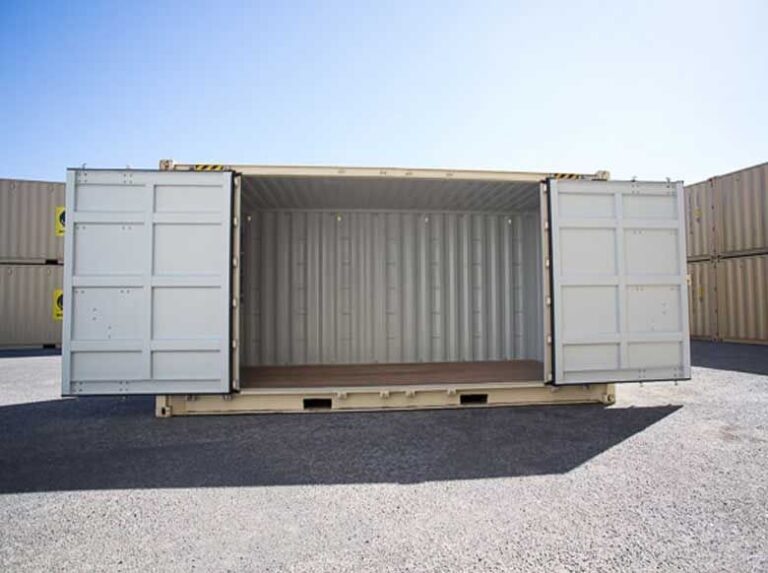
Shipping Container Door Dimensions
The door opening is another measurement buyers sometimes overlook.
The container may have enough interior space for an item, but the item still needs to physically pass through the door.
Before purchasing, check:
- Door opening width
- Door opening height
- Item width
- Item height
- Packaging dimensions
This is particularly important for:
- Vehicles
- Machinery
- Large equipment
- Palletized goods
- Oversized items
Don’t measure only the storage space inside the container.
Why Container Width Matters
Most standard shipping containers are approximately 8ft wide externally.
This makes width particularly important when determining whether the container will fit:
- Between buildings
- Through gates
- Along driveways
- Beside property boundaries
- In designated storage areas
Measure the actual available width of your installation area before ordering.
Also allow sufficient space for delivery equipment and access.
Shipping Container Dimensions and Foundation Size
The foundation should be planned according to the actual container dimensions.
A 10ft container requires less foundation length than a 40ft container.
Similarly, a 45ft container requires a longer prepared area.
The foundation should provide stable support and appropriate drainage.
For more information, read Shipping Container Foundations: Everything You Need to Know (2026).
Shipping Container Dimensions and Delivery
The container’s dimensions aren’t the only measurements you need to consider.
You should also evaluate the delivery route.
Check:
Road width
Can the delivery vehicle access your property?
Turning space
Are there tight corners or narrow entrances?
Overhead clearance
Are there trees, utility lines, bridges, or other obstacles?
Gate width
Can the delivery equipment enter the property?
Placement area
Is there sufficient space for the container and unloading process?
Our How Shipping Container Delivery Works: What Buyers Need to Know (2026) guide explains the process.
You should also review How to Prepare Your Property for Shipping Container Delivery (2026) before ordering.
How Much Space Should You Leave Around a Container?
Don’t plan the installation based solely on the container’s exact footprint.
You may need additional space for:
- Opening doors
- Walking around the container
- Maintenance
- Inspection
- Drainage
- Delivery
- Security
- Future access
The amount of additional space required depends on your property and how the container will be used.
Choosing a Container Based on Dimensions
The best container isn’t necessarily the largest one available.
Instead, consider:
How much space do I need?
Then:
How much space does my property have?
And finally:
Can the container be delivered and properly installed?
For example:
Small storage requirements
Consider:
General-purpose storage
Consider:
Intermediate storage
Consider:
Large storage requirements
Consider:
Maximum length among your standard options
Consider:
Additional vertical space
Consider:
Standard vs. High Cube Dimensions
The additional height of a High Cube can be useful, but it also creates another consideration: overhead clearance.
Before purchasing a High Cube container, check:
- Delivery route
- Property entrance
- Utility lines
- Tree branches
- Final placement area
For the full comparison, read Standard vs. High Cube Shipping Containers: What’s the Difference? (2026).
Dimensions for Used Shipping Containers
If you’re buying a Used Shipping Container, don’t assume every unit has exactly the same dimensions as a new unit of the same nominal size.
The container may have:
- Repairs
- Modifications
- Different door configurations
- Different construction specifications
Confirm the actual dimensions of the specific container you’re purchasing.
You can learn more about evaluating used units in Used Shipping Containers for Sale: The Complete Buyer’s Guide (2026).
How Dimensions Affect Container Price
Container dimensions can influence the purchase price, but size isn’t the only factor.
Pricing can also depend on:
- Container condition
- Location
- Availability
- Delivery
- Container type
- Modifications
- Market conditions
A larger container generally provides more capacity, but you should compare the total cost against your actual storage needs.
See How Much Does a Shipping Container Cost in 2026? Complete Pricing Guide for additional information.
Common Dimension Mistakes to Avoid
❌ Measuring only the container location
You also need to consider the delivery route.
❌ Ignoring door dimensions
Your equipment must fit through the opening.
❌ Forgetting overhead clearance
This is particularly important for High Cube containers.
❌ Assuming nominal dimensions are exact
Always verify the manufacturer’s actual specifications.
❌ Forgetting foundation space
Your prepared foundation must accommodate the container properly.
❌ Choosing the largest container automatically
More storage space isn’t necessarily better if your property or needs don’t require it.
Shipping Container Dimension Checklist
Before purchasing, confirm:
☐ External length
☐ External width
☐ External height
☐ Internal length
☐ Internal width
☐ Internal height
☐ Door opening width
☐ Door opening height
☐ Container weight
☐ Foundation dimensions
☐ Delivery access
☐ Overhead clearance
☐ Final placement area
If you’re storing a specific item, measure the item and compare those measurements against the actual usable interior and door opening dimensions.
Frequently Asked Questions
What is the standard width of a shipping container?
Most standard shipping containers are approximately 8ft wide externally, although exact dimensions can vary.
How tall is a standard shipping container?
A typical standard-height container is approximately 8ft 6in externally.
How tall is a High Cube container?
A typical High Cube container is approximately 9ft 6in externally.
What is the longest common shipping container?
Among the size categories covered by Universal Container Depot, 45ft containers provide a longer standard option than 40ft containers.
Does a 40ft container have twice the storage of a 20ft container?
It is approximately twice as long, but actual usable capacity depends on the specific internal dimensions and configuration.
Do shipping container dimensions vary?
Yes. Dimensions can vary by manufacturer, model, configuration, and container type. Always verify the specifications of the specific unit before purchase.
Final Thoughts
Understanding shipping container dimensions helps you avoid one of the most common purchasing mistakes: choosing a container that doesn’t properly fit your property, storage requirements, or delivery route.
Start by determining how much interior space you need, then compare the available lengths and heights.
For smaller storage needs, a 10ft Container may be appropriate. For general-purpose storage, a 20ft Container can provide a versatile solution. Larger requirements may call for 30ft, 40ft, or 45ft Containers.
If vertical space is important, consider a High Cube Container.
Before ordering, always confirm the exact dimensions of the specific container and make sure your property is prepared for delivery and installation.
When you’re ready to find the right container for your needs, explore Shipping Containers and compare the available sizes and configurations.
For more information about international shipping container standards, visit the International Maritime Organization (IMO)